
GLP-1 Receptor Agonists and Bone Health
In a recent article, we discussed the prominent misinformation about GLP-1 receptor agonists (GLP-1RAs) and lean mass/muscle loss. Herein, we will focus on the effects of GLP-1RAs on bone!
Many people have heard that GLP-1RAs detrimentally impact bone mineral density (BMD) or other markers of bone health. However, the exact extent to which these medications affect the skeleton is unclear, and likely depends on baseline metabolic status and age when these drugs are administered. Let’s explore what the research indicates in terms of GLP-1RAs and bone health.
To start, we should begin with the idea that bone health and metabolism* is a critical aspect of development that occurs during adolescence. In fact, skeletal growth and bone accrual exhibit rapid growth during adolescence (Weaver, 2002): Approximately 40% to 60% of adult bone mass is accrued during the adolescent years (Golden et al., 2014), and bone mass attained during this period is one of the most important modifiable determinants of lifelong skeletal health, including the prevention of osteoporosis (NIH Consensus Development Panel on Osteoporosis Prevention, 2001). Adolescence is therefore a critical period for skeletal mineralization, necessitating diets that provide adequate nutrition and calcium for proper bone formation (Bailey et al., 2000; Prentice et al., 2006; Proia et al., 2021). Thus, the use of appetite-reducing GLP-1RAs during this period raises concerns for appropriate nutrient intake and associated skeletal development.
Despite the potential implications of inadequate vitamin/mineral intake, available adolescent clinical data do not indicate direct impairment of skeletal development during treatment with GLP-1RAs (Kelly et al., 2020; Weghuber et al., 2022). If found to exist, potential effects of GLP-1RAs on bone physiology may be closely tied to weight loss (rather than direct effects of GLP-1RAs on bone): A study of adolescent bariatric surgery found that weight loss associated with sleeve gastrectomy in had negative effects on areal BMD and certain other bone parameters (HRpQCT) compared to a control group during follow-up after surgery**, despite bone strength estimates remaining stable (Misra et al., 2020). However, a meta-analysis of children and adolescents who underwent significant weight loss from bariatric surgery reported no impairments in bone mass (Bezerra et al., 2024). These conflicting results may be due to differences in age, pubertal status, baseline bone health, genetic predispositions, or lifestyle factors between studies, but indicate that more research is needed to parse the effects of weight loss on skeletal development in adolescents.
While GLP-1RAs haven’t been shown to impact bone health in adolescents, in adults the literature is mixed. Interestingly, preclinical evidence reports that GLP-1RAs improve overall bone structure and strength by increasing bone formation and decreasing bone resorption (see figure below; Daniilopoulou et al., 2022). However, the clinical impact of GLP-1RAs on bone physiology is confounded by the varied findings observed in human trials:
In a clinical trial of 195 adults, daily administration of 3.0 mg liraglutide reduced hip and spine bone mineral density compared with placebo or exercise. However, the combination of exercise and liraglutide preserved hip, spine, and forearm bone mineral density despite larger weight loss (Jensen et al., 2024).
In patients with type 2 diabetes (T2D), who are at an increased risk of fragility fractures, the use of GLP1-RAs consistently reduces fracture risk and benefits overall bone metabolism (Kong et al., 2021).
In adults with increased fracture risk without T2D, semaglutide (1.0 mg weekly) did not increase bone formation, and in fact lowered lumbar spine and total hip areal bone mineral densities compared to placebo after 52 weeks. It is unknown whether these effects represented skeletal adaptations to lower mechanical loading following weight reduction, direct effect of semaglutide on bone, or a combination (M. S. Hansen et al., 2024).
Thus, GLP-1RAs have the ability to directly modulate bone regulatory pathways, tending to increase formation and decrease resorption. However, whether this is beneficial or detrimental is poorly understood, as the body is constantly and dynamically regulating bone activity depending on the metabolic state of the organism. In addition, trials in humans portray conflicting results, and the specific effects of GLP-1RAs on bone health vary according to baseline health status. While it appears that GLP-1RAs are beneficial for individuals with T2D, and any potential negative effects for individuals without T2D may be offset by exercise, more research is necessary to understand the full system-wide skeletal impacts of these medications.
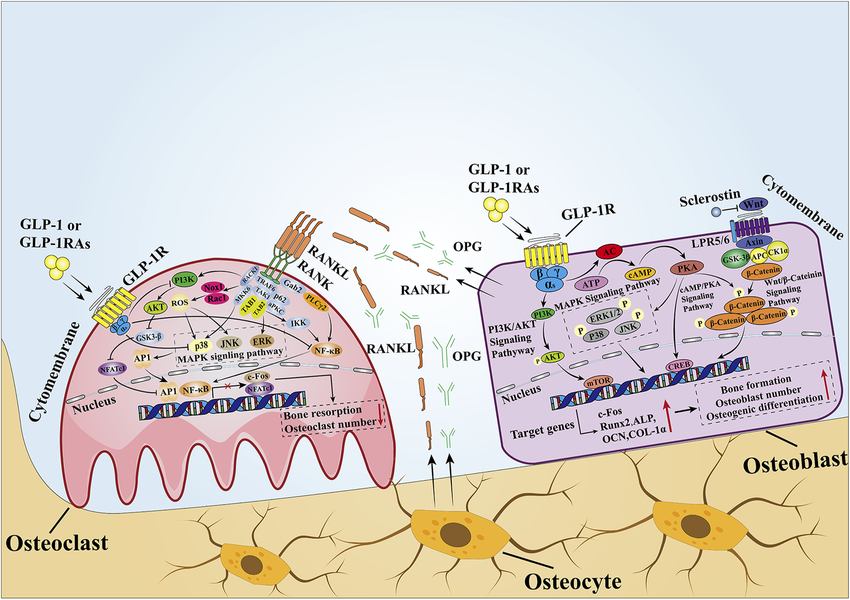
This image, while understandably busy and confusing, shows the mechanistic pathway by which GLP-1RAs increase bone formation. While it is not important to memorize this information, it is provided to demonstrate how, exactly, these medications impact bone metabolism. (Liu et al., 2024)
It is important to note that bone strength is especially important during older adulthood. The skeleton naturally loses about 0.5-1% BMD every year starting around the age of 40, meaning that the skeleton is naturally more fragile, simply due to age, by the time someone is in their 60s and above. Furthermore, during menopause, women lose 2% to 5% of BMD annually for several years as a result of decreasing estrogen. We know that falls during late adulthood are a large predictor of life- and health-span, particularly if they result in a fracture. Thus, prioritizing bone health during this period is essential for health aging. GLP-1RAs have not been studied in this older age group, so no data about their impact on bone health is available. As previously mentioned, bone mass attained during adolescence is the biggest variable for determining bone health in adulthood. However, consistent strength training and proper nutrient intake (particularly calcium and vitamin D) are crucial factors one can incorporate at any time to offset natural age-related declines in bone strength.
Overall, the impact of GLP-1RAs on bone health is heterogeneous and dependent upon the baseline metabolic characteristics of individuals. While the direct effects of GLP-1RAs on bone may promote bone formation, rapid weight loss induced by these medications may detrimentally impact bone health. Lastly, the sensitivity of adolescent bone accrual to energy balance and weight loss warrants continued longitudinal evaluation.
Notes
*Bone metabolism, the formation or reabsorption of bone, is modulated in part by insulin action (Ravindran et al., 2025).
**Let’s take a quick moment to point out that weight loss, from any intervention, will likely decrease BMD. This is because bone strength is load-dependent; that is, the bone requires external stressors to stimulate growth and structure. Individuals with higher body weight naturally place more load on their bones, which forces the bones to adapt to this stress through increases in density. When excess body weight is lost, there is less loading on the bones, which weakens the drive to provide a higher BMD. This is why strength training and other load bearing exercises are so important for skeletal health! The more force exerted on your bones, the greater the stimulus for increased bone strength.
References
Bailey, D. A., Martin, A. D., McKay, H. A., Whiting, S., & Mirwald, R. (2000). Calcium Accretion in Girls and Boys During Puberty: A Longitudinal Analysis. Journal of Bone and Mineral Research, 15(11), 2245–2250. https://doi.org/10.1359/jbmr.2000.15.11.2245
Bezerra, A., Boppre, G., Freitas, L., Battista, F., Duregon, F., Faggian, S., Busetto, L., Ermolao, A., & Fonseca, H. (2024). Body Composition Changes in Adolescents Who Underwent Bariatric Surgery: A Systematic Review and Meta-analysis. Current Obesity Reports, 13(1), 107–120. https://doi.org/10.1007/s13679-023-00549-6
Daniilopoulou, I., Vlachou, E., Lambrou, G. I., Ntikoudi, A., Dokoutsidou, E., Fasoi, G., Govina, O., Kavga, A., & Tsartsalis, A. N. (2022). The Impact of GLP1 Agonists on Bone Metabolism: A Systematic Review. Medicina, 58(2), 224. https://doi.org/10.3390/medicina58020224
Golden, N. H., Abrams, S. A., COMMITTEE ON NUTRITION, Daniels, S. R., Abrams, S. A., Corkins, M. R., de Ferranti, S. D., Golden, N. H., Magge, S. N., & Schwarzenberg, S. J. (2014). Optimizing Bone Health in Children and Adolescents. Pediatrics, 134(4), e1229–e1243. https://doi.org/10.1542/peds.2014-2173
Hansen, M. S., Wölfel, E. M., Jeromdesella, S., Møller, J.-J. K., Ejersted, C., Jørgensen, N. R., Eastell, R., Hansen, S. G., & Frost, M. (2024). Once-weekly semaglutide versus placebo in adults with increased fracture risk: A randomised, double-blinded, two-centre, phase 2 trial. eClinicalMedicine, 72. https://doi.org/10.1016/j.eclinm.2024.102624
Jensen, S. B. K., Sørensen, V., Sandsdal, R. M., Lehmann, E. W., Lundgren, J. R., Juhl, C. R., Janus, C., Ternhamar, T., Stallknecht, B. M., Holst, J. J., Jørgensen, N. R., Jensen, J.-E. B., Madsbad, S., & Torekov, S. S. (2024). Bone Health After Exercise Alone, GLP-1 Receptor Agonist Treatment, or Combination Treatment: A Secondary Analysis of a Randomized Clinical Trial. JAMA Network Open, 7(6), e2416775. https://doi.org/10.1001/jamanetworkopen.2024.16775
Kelly, A. S., Auerbach, P., Barrientos-Perez, M., Gies, I., Hale, P. M., Marcus, C., Mastrandrea, L. D., Prabhu, N., & Arslanian, S. (2020). A Randomized, Controlled Trial of Liraglutide for Adolescents with Obesity. New England Journal of Medicine, 382(22), 2117–2128. https://doi.org/10.1056/NEJMoa1916038
Kong, Q., Ruan, Q., Fan, C., Liu, B.-L., Reng, L.-P., & Xu, W. (2021). Evaluation of the risk of fracture in type 2 diabetes mellitus patients with incretins: An updated meta-analysis. Endokrynologia Polska, 72(4), 319–328. https://doi.org/10.5603/EP.a2021.0031
Misra, M., Singhal, V., Carmine, B., Bose, A., Kelsey, M. M., Stanford, F. C., Bram, J., Aidlen, J., Inge, T., Bouxsein, M. L., & Bredella, M. A. (2020). Bone Outcomes Following Sleeve Gastrectomy in Adolescents and Young Adults with Obesity Versus Non-Surgical Controls. Bone, 134, 115290. https://doi.org/10.1016/j.bone.2020.115290
NIH Consensus Development Panel on Osteoporosis Prevention, D., and Therapy. (2001). Osteoporosis Prevention, Diagnosis, and Therapy. JAMA, 285(6), 785–795. https://doi.org/10.1001/jama.285.6.785
Prentice, A., Schoenmakers, I., Laskey, M. A., de Bono, S., Ginty, F., & Goldberg, G. R. (2006). Symposium on ‘Nutrition and health in children and adolescents’ Session 1: Nutrition in growth and development. The Proceedings of the Nutrition Society, 65(4), 348–360. https://doi.org/10.1017/s0029665106005192
Proia, P., Amato, A., Drid, P., Korovljev, D., Vasto, S., & Baldassano, S. (2021). The Impact of Diet and Physical Activity on Bone Health in Children and Adolescents. Frontiers in Endocrinology, 12, 704647. https://doi.org/10.3389/fendo.2021.704647
Ravindran, S., Wong, S. K., Mohamad, N.-V., & Chin, K.-Y. (2025). A Review of the Relationship Between Insulin and Bone Health. Biomedicines, 13(6), 1504. https://doi.org/10.3390/biomedicines13061504
Weaver, C. M. (2002). Adolescence. Endocrine, 17(1), 43–48. https://doi.org/10.1385/ENDO:17:1:43
Weghuber, D., Barrett, T., Barrientos-Pérez, M., Gies, I., Hesse, D., Jeppesen, O. K., Kelly, A. S., Mastrandrea, L. D., Sørrig, R., & Arslanian, S. (2022). Once-Weekly Semaglutide in Adolescents with Obesity. The New England Journal of Medicine, 387(24), 2245–2257. https://doi.org/10.1056/NEJMoa2208601
