
GLP-1 Receptor Agonists and Lean Mass
I can’t tell you how many times I’ve heard this (or something similar): “GLP-1 agonists are harmful because they cause such a large amount of lean mass/muscle loss.” But let me tell you something—much of this information is straight fear-mongering, news and social media derived nonsense posted for clicks and views, designed to incite distrust and confusion. I’ve been immersed in the literature surrounding the use of GLP-1s for the past several years, and these medications were the topic of my PhD dissertation research. While all medications, especially those that are relatively new, should be viewed with a certain degree of skepticism, overstating the potential harms is not helpful. Thus, I want to help you all understand what is actually known about GLP-1 Receptor Agonists (GLP-1RAs) and lean mass loss.
TL;DR: GLP-1RA–induced weight loss is unlikely to disproportionately compromise muscle health. In fact, GLP-1RAs preferentially reduce fat mass while increasing the relative proportion of lean mass and preserving muscle strength. Mechanistic studies further suggest that GLP-1RAs may promote favorable skeletal muscle remodeling that enhances muscle endurance. If you are an individual currently taking a GLP-1RA, best practice to reduce muscle loss is to do regular resistance training (2-3 times per week), ensure adequate protein intake (~1 gram per pound of body weight per day), and prioritize sleep (a critical period for muscle recovery!).
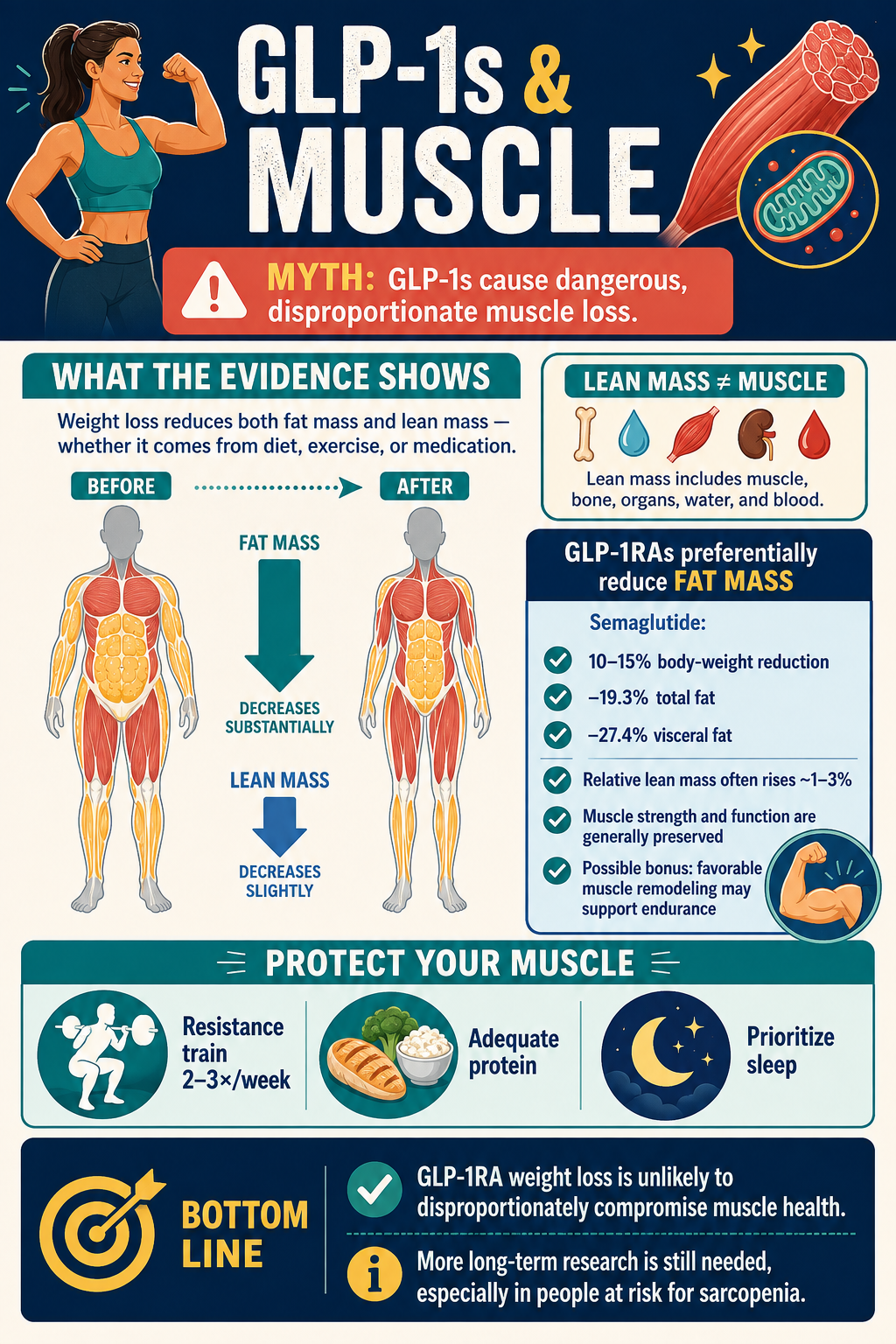
Image Created with ChatGPT.
First of all, any weight loss intervention—dieting, exercise, medications, etc.—reduces both fat mass and lean mass. Why? Because, in part, if an individual no longer carries as much weight, there is less need for more lean mass to support that weight. Before we go further, let’s get really clear with what we’re talking about: Lean mass is everything in your body except fat—that is, muscle, bone, organ, water, and blood. Thus, with less body weight in general, there will undoubtedly be less of at least some of these lean mass components.
What most people are likely concerned about in terms of lean mass loss is the loss of either muscle or bone. Both of these tissues are essential for optimal health, providing not only structural support, but also serving important metabolic and functional roles. For this article, let’s focus on lean mass in general, and muscle in particular. (See this article for information about GLP-1RAs and bone!)
Muscle loss can lead to reduced functional and metabolic health, weight cycling, compromised quality of life, and other adverse outcomes (Prado et al., 2018). However, as mentioned, it is inevitable than some loss of lean mass will accompany fat loss during weight loss interventions (McCarthy & Berg, 2021). For example, during non-pharmacologic caloric restriction, declines in lean mass typically account for 10%–30% of the total body weight reduction, although this percentage is not constant and trends higher in people rapidly experiencing large weight reductions, such as what is observed with GLP-1RA therapy (Chaston et al., 2007).
Here’s the good news: In adults with obesity, GLP-1RAs primarily induce weight loss by reducing fat mass. Although reductions in lean mass are also typically observed, GLP-1RA therapy consistently enhances the relative proportion of lean mass, with minimal or non-clinically relevant impacts on muscle strength and function (Neeland et al., 2024). GLP-1RAs may therefore provide beneficial outcomes for muscle health during weight loss.
In general, treatment with the GLP-1RA semaglutide reduces body weight by approximately 10–15%, driven predominantly by decreases in total and visceral fat mass (-19.3% and -27.4%, respectively, for the major semaglutide STEP-1 trial (Wilding et al., 2021a; Wilding et al., 2021b)), with proportionally smaller and clinically insignificant reductions in lean mass (Chun et al., 2025; McCrimmon et al., 2020; Rodríguez Jiménez et al., 2024; Volpe et al., 2022; Wilding et al., 2021a; Wilding et al., 2021b). Such reductions in muscle size and strength resulting from GLP-1RA therapy are not any more severe than that resulting from caloric restriction (Jeromson et al., 2025). Importantly, the relative proportion of lean mass often increases following treatment (ranging from about +1.0 to +3.0%), and skeletal muscle strength and tissue integrity remain preserved, indicating maintenance of functional muscle despite overall weight loss (Rodríguez Jiménez et al., 2024; Volpe et al., 2022).
Similar patterns have been observed with the GLP-1RA liraglutide, which preferentially reduces fat mass, including visceral adiposity, while largely preserving lean tissue, as explored in extensive review by Schmidt et al. (2025). Furthermore, liraglutide administered following caloric restriction promotes additional fat loss without further reductions in lean mass and, when combined with exercise, may increase absolute lean mass (Lundgren et al., 2021). This is an extremely important point—all individuals, regardless of weight status or medication usage, should be doing regular resistance/strength training, ideally 2-3 times per week! Resistance training strongly supports physical and metabolic health, immediately and in the future. In particular, for individuals using GLP-1RA therapy, resistance training can prevent the loss of lean mass that is typically associated with weight loss!
Interestingly, loss of lean mass and skeletal muscle that does occur during GLP-1RA use recovers following treatment discontinuation, similarly to the rebound of fat mass (Jeromson et al., 2025). Muscle transcriptomic analyses* also reveal distinct molecular responses with semaglutide compared to a diet of the same caloric intake (Jeromson et al., 2025). These responses promote GLP-1-induced skeletal muscle remodeling**, which boost mitochondrial content and oxidative phosphorylation and significantly increase glucose uptake, the expression of slow-twitch fiber marker genes, and respiration capacity. The net effect of this signaling cascade is the enhancement of endurance capacity (Wu et al., 2022). Improvements in insulin sensitivity, as seen with GLP-1RA administration, also contribute to an adaptive process of muscle mass and function, as explained in a detailed review by Cava et al. (2017). Together, these findings suggest that, in adults, GLP-1RA-induced weight loss primarily reflects adipose tissue reduction, leading to a positive increase in the lean-to-fat mass ratio.
While GLP-1RA-induced reductions in lean mass appear modest relative to losses in fat mass, a major concern associated with any decline in lean tissue is its potential impact on energy expenditure, particularly resting metabolic rate (RMR). Because skeletal muscle is a metabolically active tissue and contributes substantially to resting energy expenditure, reductions in lean mass could theoretically promote metabolic adaptation and increase susceptibility to weight regain. However, current evidence suggests that GLP-1RA therapy does not substantially reduce energy expenditure beyond what would be expected from changes in body composition. A recent scoping review concluded that GLP-1RA monotherapy and combination therapies exert minimal effects on energy expenditure, including RMR, regardless of treatment duration or magnitude of weight loss (Vieira et al., 2026). Furthermore, preclinical and clinical studies indicate that incretin-based therapies may attenuate the decline in energy expenditure typically observed during weight loss while promoting greater fat oxidation (Corbin et al., 2023; Raun et al., 2007; Ravussin et al., 2025).
Overall, concerns regarding lean mass loss during GLP-1RA–induced weight loss are particularly important given the metabolic and functional importance of skeletal muscle. Although some loss of lean tissue inevitably accompanies weight loss, adult data consistently demonstrate that GLP-1RAs preferentially reduce fat mass while increasing the relative proportion of lean mass and preserving muscle strength. Mechanistic studies further suggest that GLP-1RAs may promote favorable skeletal muscle remodeling that enhances muscle endurance. Thus, GLP-1RA–induced weight loss is unlikely to disproportionately compromise muscle health, although further longitudinal studies are needed to determine how pharmacologic weight reduction influences long-term lean mass regulation. Furthermore, more research is needed for individuals with a history or increased risk of sarcopenia (age-related loss of muscle mass, strength, and function).
Notes
*Global gene expression patterns in muscle tissue.
**Via GLP-1R/AMP activated protein kinase (AMPK) signaling pathway.
References
Cava, E., Yeat, N. C., & Mittendorfer, B. (2017). Preserving Healthy Muscle during Weight Loss123. Advances in Nutrition, 8(3), 511–519. https://doi.org/10.3945/an.116.014506
Chaston, T. B., Dixon, J. B., & O’Brien, P. E. (2007). Changes in fat-free mass during significant weight loss: A systematic review. International Journal of Obesity, 31(5), 743–750. https://doi.org/10.1038/sj.ijo.0803483
Chun, E., Siojo, A., Rivera, D., Reyna, K., Legere, H., Joseph, R., & Pojednic, R. (2025). Weight loss and body composition after compounded semaglutide treatment in a real world setting. Diabetes, Obesity and Metabolism, 27(3), 1536–1543. https://doi.org/10.1111/dom.16162
Corbin, K. D., Carnero, E. A., Allerton, T. D., Tillner, J., Bock, C. P., Luyet, P.-P., Göbel, B., Hall, K. D., Parsons, S. A., Ravussin, E., & Smith, S. R. (2023). GLP-1/Glucagon Receptor Agonism Associates with Reduced Metabolic Adaptation and Higher Fat Oxidation: A Randomized Trial. Obesity (Silver Spring, Md.), 31(2), 350–362. https://doi.org/10.1002/oby.23633
FDA. (2025, June 4). Obesity and Overweight: Developing Drugs and Biological Products for Weight Reduction [Center for Drug Evaluation and Research]. U.S. Food & Drug Administration. https://www.fda.gov/regulatory-information/search-fda-guidance-documents/obesity-and-overweight-developing-drugs-and-biological-products-weight-reduction
Jeromson, S., Baranowski, B., Akcan, M., Waters, B. D., Eisner, K., Bellucci, A., Trang, S., Abolhassani, A., Tello-Palencia, M. A., Schweitzer, A., Stefanska, B., Mitchell, C. J., & Wright, D. C. (2025). Semaglutide impacts skeletal muscle to a similar extent as caloric restriction in mice with diet-induced obesity. The Journal of Physiology, n/a(n/a). https://doi.org/10.1113/JP289449
Lundgren, J. R., Janus, C., Jensen, S. B. K., Juhl, C. R., Olsen, L. M., Christensen, R. M., Svane, M. S., Bandholm, T., Bojsen-Møller, K. N., Blond, M. B., Jensen, J.-E. B., Stallknecht, B. M., Holst, J. J., Madsbad, S., & Torekov, S. S. (2021). Healthy Weight Loss Maintenance with Exercise, Liraglutide, or Both Combined. New England Journal of Medicine, 384(18), 1719–1730. https://doi.org/10.1056/NEJMoa2028198
McCarthy, D., & Berg, A. (2021). Weight Loss Strategies and the Risk of Skeletal Muscle Mass Loss. Nutrients, 13(7), 2473. https://doi.org/10.3390/nu13072473
McCrimmon, R. J., Catarig, A.-M., Frias, J. P., Lausvig, N. L., le Roux, C. W., Thielke, D., & Lingvay, I. (2020). Effects of once-weekly semaglutide vs once-daily canagliflozin on body composition in type 2 diabetes: A substudy of the SUSTAIN 8 randomised controlled clinical trial. Diabetologia, 63(3), 473–485. https://doi.org/10.1007/s00125-019-05065-8
Neeland, I. J., Linge, J., & Birkenfeld, A. L. (2024). Changes in lean body mass with glucagon-like peptide-1-based therapies and mitigation strategies. Diabetes, Obesity and Metabolism, 26(S4), 16–27. https://doi.org/10.1111/dom.15728
Prado, C. M., Purcell, S. A., Alish, C., Pereira, S. L., Deutz, N. E., Heyland, D. K., Goodpaster, B. H., Tappenden, K. A., & Heymsfield, S. B. (2018). Implications of Low Muscle Mass across the Continuum of Care: A Narrative Review. Annals of Medicine, 50(8), 675–693. https://doi.org/10.1080/07853890.2018.1511918
Raun, K., von Voss, P., Gotfredsen, C. F., Golozoubova, V., Rolin, B., & Knudsen, L. B. (2007). Liraglutide, a Long-Acting Glucagon-Like Peptide-1 Analog, Reduces Body Weight and Food Intake in Obese Candy-Fed Rats, Whereas a Dipeptidyl Peptidase-IV Inhibitor, Vildagliptin, Does Not. Diabetes, 56(1), 8–15. https://doi.org/10.2337/db06-0565
Ravussin, E., Sanchez-Delgado, G., Martin, C. K., Beyl, R. A., Greenway, F. L., O’Farrell, L. S., Roell, W. C., Qian, H.-R., Li, J., Nishiyama, H., Haupt, A., Pratt, E. J., Urva, S., Milicevic, Z., & Coskun, T. (2025). Tirzepatide did not impact metabolic adaptation in people with obesity, but increased fat oxidation. Cell Metabolism. https://doi.org/10.1016/j.cmet.2025.03.011
Rodríguez Jiménez, B., Rodríguez de Vera Gómez, P., Belmonte Lomas, S., Mesa Díaz, Á. M., Caballero Mateos, I., Galán, I., Morales Portillo, C., & Martínez-Brocca, M. A. (2024). Transforming body composition with semaglutide in adults with obesity and type 2 diabetes mellitus. Frontiers in Endocrinology, 15, 1386542. https://doi.org/10.3389/fendo.2024.1386542
Rojas, J., Arraiz, N., Aguirre, M., Velasco, M., & Bermúdez, V. (2011). AMPK as Target for Intervention in Childhood and Adolescent Obesity. Journal of Obesity, 2011, 252817. https://doi.org/10.1155/2011/252817
Schmidt, P. H. S., Pasqualotto, E., Dos Santos, H. V., de Souza, L. S. N., Dos Santos, B. E., Chavez, M. P., Ferreira, R. O. M., Hohl, A., Ronsoni, M. F., & van de Sande-Lee, S. (2025). Effects of liraglutide on body composition in people living with obesity or overweight: A systematic review. Obesity Research & Clinical Practice, 19(1), 11–18. https://doi.org/10.1016/j.orcp.2025.01.009
Vieira, F. T., Deng, Z., Muller, M. J., Bergamasco, G. G. L., Cawsey, S., Manco, M., Heymsfield, S. B., Prado, C. M., & Haqq, A. M. (2026). Effects of Glucagon-Like Peptide-1 Receptor Agonists (Mono and Combination Therapy) on Energy Expenditure: A Scoping Review. Obesity Reviews, n/a(n/a), e70116. https://doi.org/10.1111/obr.70116
Volpe, S., Lisco, G., Racaniello, D., Fanelli, M., Colaianni, V., Vozza, A., Triggiani, V., Sabbà, C., Tortorella, C., De Pergola, G., & Piazzolla, G. (2022). Once-Weekly Semaglutide Induces an Early Improvement in Body Composition in Patients with Type 2 Diabetes: A 26-Week Prospective Real-Life Study. Nutrients, 14(12), 2414. https://doi.org/10.3390/nu14122414
Wilding et al., 2021a: Wilding, J. P. H., Batterham, R. L., Calanna, S., Davies, M., Gaal, L. F. V., Lingvay, I., McGowan, B. M., Rosenstock, J., Tran, M. T. D., Wadden, T. A., Wharton, S., Yokote, K., Zeuthen, N., & Kushner, R. F. (2021). Once-Weekly Semaglutide in Adults with Overweight or Obesity. New England Journal of Medicine, 384(11), 989–1002. https://doi.org/10.1056/NEJMoa2032183
Wilding et al., 2021b: Wilding, J. P. H., Batterham, R. L., Calanna, S., Van Gaal, L. F., McGowan, B. M., Rosenstock, J., Tran, M. T. D., Wharton, S., Yokote, K., Zeuthen, N., & Kushner, R. F. (2021). Impact of Semaglutide on Body Composition in Adults With Overweight or Obesity: Exploratory Analysis of the STEP 1 Study. Journal of the Endocrine Society, 5(Suppl 1), A16–A17. https://doi.org/10.1210/jendso/bvab048.030
Wu, L., Zhou, M., Li, T., Dong, N., Yi, L., Zhang, Q., & Mi, M. (2022). GLP-1 regulates exercise endurance and skeletal muscle remodeling via GLP-1R/AMPK pathway. Biochimica et Biophysica Acta (BBA) - Molecular Cell Research, 1869(9), 119300. https://doi.org/10.1016/j.bbamcr.2022.119300
