
GLP-1 Supplements
You’ve probably seen them: “Double your GLP-1 levels.” “Activate your body’s GLP-1 production.” “GLP-1 Booster!” These supplement claims hinge on the now ubiquitous popularity and known weight loss efficacy of GLP-1 agonists such as Ozempic and Wegovy. But can supplements actually increase GLP-1 levels, and does this increase have any noticeable effect?
TLDR: If you’re in search of the robust hunger suppressing and weight loss effects of GLP-1 agonists, such as those imparted by Ozempic, GLP-1 supplements will be unlikely to hit the mark. While they may provide marginal benefits for reducing hunger and blood sugar control, a more sustainable (and more economical!) approach is to prioritize consuming whole foods that are high in fiber and vitamins/minerals. The consumption of such foods will naturally elevate your GLP-1 levels to a similar degree as that of supplements. If you really need to lose a significant amount of weight, talk to your doctor about GLP-1 agonists, which thus far have demonstrated remarkable weight loss with a markedly robust safety profile.
First, it will be helpful to understand a bit of the basics: GLP-1, or glucagon-like peptide-1, is a naturally occurring hormone that is released from cells in your intestine in response to nutrient intake. That is, when you consume food, GLP-1 is naturally released. This hormone acts in several ways, including stimulating the pancreas to release insulin to move sugar in the blood (from the recently consumed food) into your cells, as well as slowing the movement of food through your stomach. GLP-1 also binds to the Vagus Nerve (yes—that one so widely known for the “mind-body connection”), which sends signals to your brain to indicate a sense of satiety. However—and this is important—GLP-1 in its natural form only has a half-life of about two minutes (due to the molecule being broken down by the enzyme DPP-IV), meaning the effects of the hormone do not last very long. In fact, little of your body’s naturally released GLP-1 even makes it into circulation. (Hansen et al., 1999) Most of the hormone’s effects result from local receptor binding (imagine a sort of “docking site” for the hormone) in the intestine, which which in turn leads to the aforementioned downstream effects. (Holst et al., 2022)
GLP-1 agonists are molecules that are structurally similar to GLP-1 and bind to the same receptors. The benefit of GLP-1 agonists, however, and the reason they are so effective at reducing body weight, is that they have been chemically modified to have an extended half life. Thus, because they stay in the body for much longer (around one week), they can have more potent effects. Like GLP-1, GLP-1 agonists stimulate insulin release, slow gastric emptying, and activate the Vagal Nerve pathway to reduce hunger. GLP-1 agonists also travel via circulation to the brain (or at least regions near the brain) and cause GLP-1 to be released from certain GLP-1-producing cells, or neurons, in the brain.* This brain-derived GLP-1 acts on reward pathways, resulting in a lower motivation or drive for food. This direct brain impact, in addition to the much longer half life of the agonists, allows for significantly prolonged action compared to our natural GLP-1, and thus result in a powerful reduction in food intake and significant weight loss.
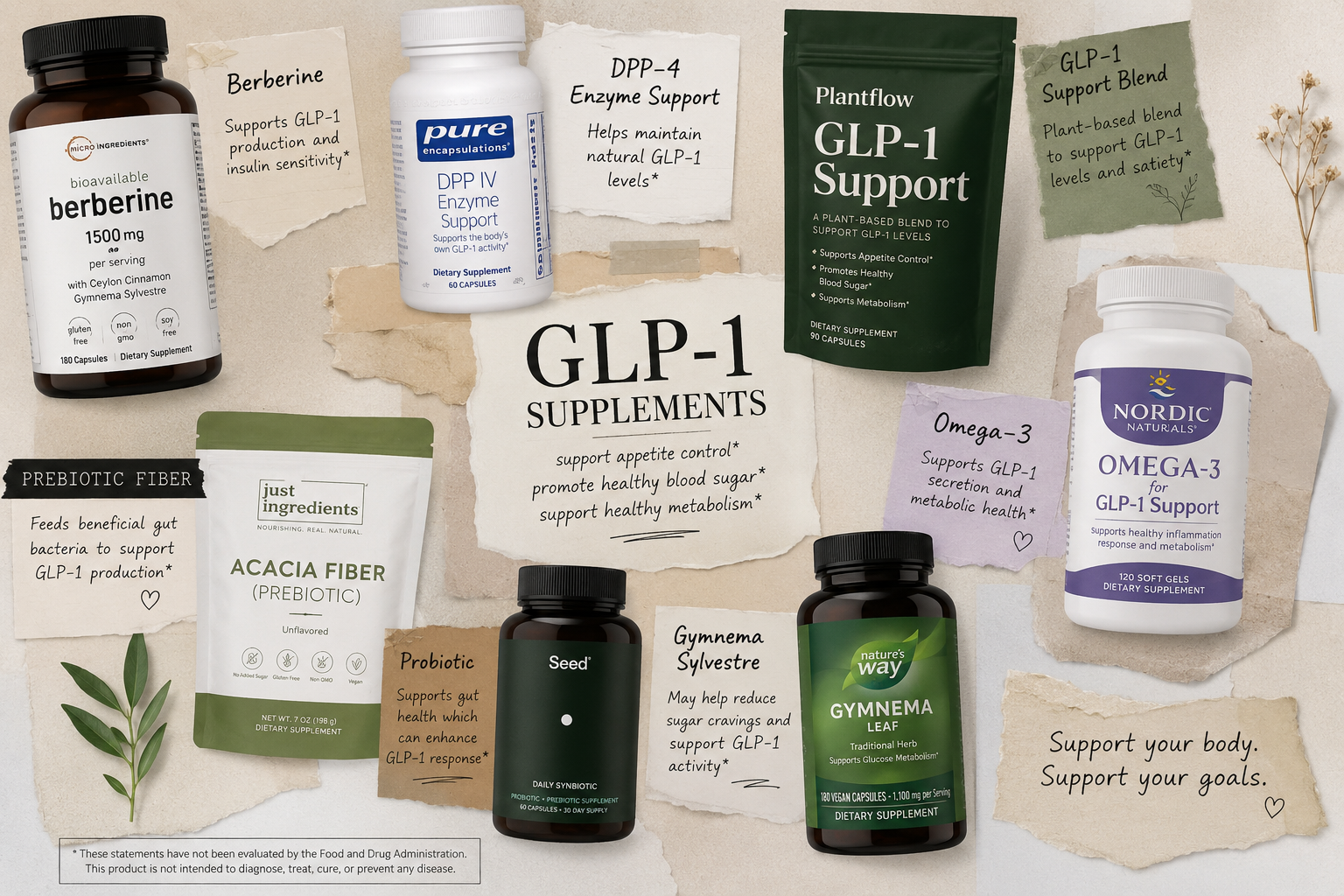
This all being said, it may now start to be apparent why supplements that claim to increase GLP-1 levels might not work how one would hope they would. (Or at least not to the same degree as GLP-1 agonists do!) GLP-1 supplements often contain like fiber, berberine, or caffeine**, some of which may stimulate weight loss, reduce hunger, or lower blood sugar through increased GLP-1 . In fact, high fiber has been shown to increase GLP-1 blood concentrations and improve postprandial glycemic responses, in part through the production of fiber fermentation byproducts known as short chain fatty acids (SCFAs). (Bodnaruc et al., 2016; Mansour et al., 2013) SCFAs feed beneficial gut microbiota to fuel the release of not only GLP-1, but other metabolism-regulating hormones (such as PYY and CCK) as well. Berberine also alters the bacterial profile, stimulating SCFA production, to induce GLP-1 secretion. (Araj-Khodaei et al., 2023)
While many supplements probably do increase GLP-1 levels, typically due to the inclusion of fiber or pre-, pro-, or post-biotics, the macronutrients in whole foods have a similar effect, with the additional benefit of vitamins, minerals, and other bioactive compounds. In general, GLP-1 secretion is regulated through meal intake, whereby GLP-1 plasma concentrations are very low in the fasted state and rise following the ingestion of food by 2- to 4-fold, and peak anywhere from 5 minutes to 60 minutes after consumption. (Watkins et al., 2021) Consumption of carbohydrates, fat, and protein all increase plasma GLP-1 levels. (Elliot et al., 1993) Fat (especially unsaturated fatty acids) appears to result in a strong and long-lasting ( > 120 min) increase of GLP-1, while that induced by glucose or amino acids (the building blocks of proteins) may be more rapid and transient. (Herrmmann et al., 2009) However, several other studies suggest that the ingestion of specific macronutrients largely results in comparable GLP-1 release, with protein-heavy meals lending greater satiety and potentially higher GLP-1 over time.*** (Watkins et al., 2021; Mansour et al., 2013) Concomitant consumption of calcium with protein may further increase plasma GLP-1. (Watkins et al., 2021)
Individuals considering GLP-1 supplements are often looking for one of two things: weight loss (mainly through reduced hunger) or blood sugar control. While GLP-1 supplements may increase GLP-1 production and therefore help modulate hunger and/or blood sugar, specifically if the supplement is high in fiber, these effects are unlikely to be very potent or long-lasting—if you’re expecting the robust hunger-suppressing and weight loss effects of GLP-1 agonists, you’re bound to be disappointed. In fact, microdosing GLP-1 agonists may provide a more effective means for weight loss and blood glucose control than GLP-1 supplements, without some of the gastrointestinal side effects of full dose GLP-1 agonists.**** (Komé et al., 2025; AgelessRx, 2025) Even more importantly than supplementation, exercise has powerful acute hunger suppression effects, along with numerous other benefits to help one consume less food and maintain healthy biomarker levels. So, if you’re looking to curb your appetite, don’t be too convinced to go out and burn your money on expensive GLP-1 supplements. First, try incorporating fiber-rich whole foods into your diet (or potentially a psyllium husk fiber supplement), and take a brief walk after meals. For individuals for whom weight loss is advised for health reasons, GLP-1 agonists will provide much more bang for your buck.
Notes
*GLP-1 agonists may also cross the blood brain barrier to directly modulate neural reward pathways. However, this theory is hotly debated, and likely depends on the specific type of GLP-1 agonist and other conditional factors.
**Ingredients such as caffeine modulate hunger through GLP-1 independent mechanisms.
***The magnitude of GLP-1 release is dependent upon the mode of ingestion, whereby the oral phase of food consumption stimulates GLP-1 production and liquid (versus solid) foods result in greater GLP-1 levels.
****Please consult your doctor before starting any medication or supplements, including GLP-1 and/or its agonists! This is for your own safety and gastrointestinal stability.
References
AgelessRx. (2025). Effectiveness of Microdosed GLP-1 in Improving Health, Quality of Life, and Longevity Measures: For Use in Healthy Individuals Ages 18-65 Who Seek to Improve Their Health and Longevity Through Low-dose (Microdosed) GLP1 Receptor Agonists (Clinical Trial Registration No. NCT07092605). clinicaltrials.gov. https://clinicaltrials.gov/study/NCT07092605
Araj-Khodaei, M., Ayati, M. H., Azizi Zeinalhajlou, A., Novinbahador, T., Yousefi, M., Shiri, M., Mahmoodpoor, A., Shamekh, A., Namazi, N., & Sanaie, S. (2024). Berberine-induced glucagon-like peptide-1 and its mechanism for controlling type 2 diabetes mellitus: A comprehensive pathway review. Archives of Physiology and Biochemistry, 130(6), 678–685. https://doi.org/10.1080/13813455.2023.2258559
Bodnaruc, A. M., Prud’homme, D., Blanchet, R., & Giroux, I. (2016). Nutritional modulation of endogenous glucagon-like peptide-1 secretion: A review. Nutrition & Metabolism, 13, 92. https://doi.org/10.1186/s12986-016-0153-3
Elliott, R. M., Morgan, L. M., Tredger, J. A., Deacon, S., Wright, J., & Marks, V. (1993). Glucagon-like peptide-1(7–36)amide and glucose-dependent insulinotropic polypeptide secretion in response to nutrient ingestion in man: Acute post-prandial and 24-h secretion patterns. https://doi.org/10.1677/joe.0.1380159
Hansen, L., Deacon, C. F., Ørskov, C., & Holst, J. J. (1999). Glucagon-Like Peptide-1-(7–36)Amide Is Transformed to Glucagon-Like Peptide-1-(9–36)Amide by Dipeptidyl Peptidase IV in the Capillaries Supplying the L Cells of the Porcine Intestine1. Endocrinology, 140(11), 5356–5363. https://doi.org/10.1210/endo.140.11.7143
Holst, J. J., Andersen, D. B., & Grunddal, K. V. (2022). Actions of glucagon-like peptide-1 receptor ligands in the gut. British Journal of Pharmacology, 179(4), 727–742. https://doi.org/10.1111/bph.15611
Komé, A. M., Chandran, M. M., Tungate Lopez, S. S., Buse, J. B., & Klein, K. R. (2025). One Size Does Not Fit All: Understanding Microdosing Semaglutide for Diabetes in Multidose Pens. Diabetes Care, 48(3), e25–e27. https://doi.org/10.2337/dc24-2575
Mansour, A., Hosseini, S., Larijani, B., Pajouhi, M., & Mohajeri-Tehrani, M. R. (2013). Nutrients related to GLP1 secretory responses. Nutrition, 29(6), 813–820. https://doi.org/10.1016/j.nut.2012.11.015
Watkins, J. D., Koumanov, F., & Gonzalez, J. T. (2021). Protein- and Calcium-Mediated GLP-1 Secretion: A Narrative Review. Advances in Nutrition, 12(6), 2540–2552. https://doi.org/10.1093/advances/nmab078
