
Urolithin A (Mitopure)
What in the heck even is it…?
TL;DR: Urolithin A, commonly sold under the brand name Mitopure, is a naturally occurring metabolite produced by gut bacteria during the digestion of some fruits and nuts. This compound plays a pivotal role in mitophagy, the breakdown and removal of damaged or dysfunctional mitochondria, which are implicated in numerous disease states. While Urolithin A is a naturally occurring gut metabolite, many people do not produce a significant amount, due to dietary deficiencies or other age- and gut-related factors. Supplementation (typically ~1 gram/day) of Urolithin A has been shown to have beneficial effects for a number of different indications, but is particularly touted for its benefits for muscle strength and endurance, as well as for promoting healthy ageing. Animals studies support these effects, and also demonstrate exciting improvement in cardiovascular, metabolic, and joint health. While outcomes in humans are more limited, with most studies investigating exercise-related endpoints, Urolithin A clearly improves biomarkers of mitochondrial health and appears to provide at least moderate improvement in muscular endurance (specifically in the older adult population), while also benefitting the immune system and overall cellular health via lowered inflammation and oxidative stress.
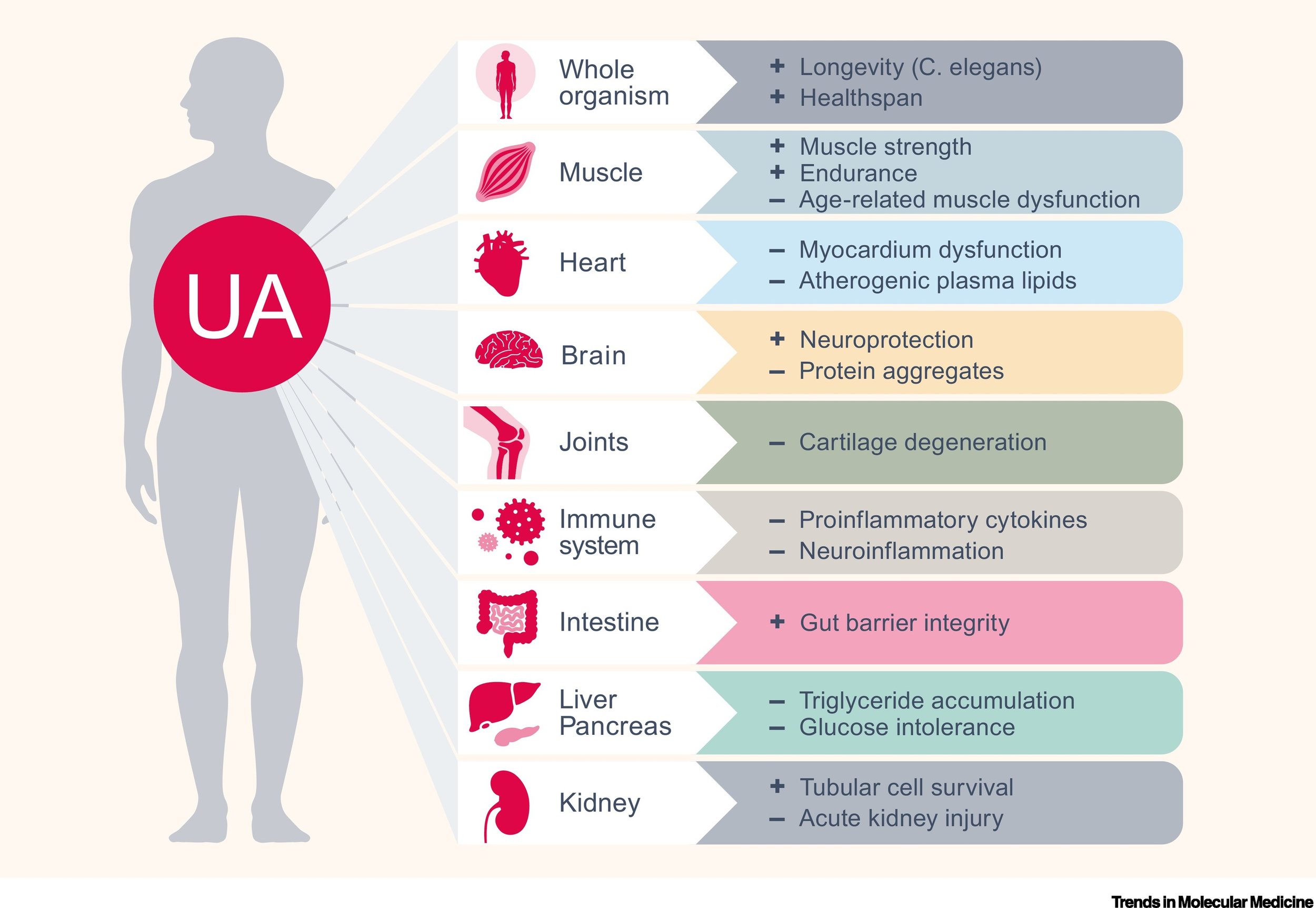
D’Amico et al., 2021
Urolithin A is a natural metabolite derived from ellagitannins, complex polyphenols found in some fruits and nuts such as pomegranates, strawberries, walnuts, and almonds. Ellagitannins serve as precursors to urolithins, undergoing microbial metabolism within the gastrointestinal tract to produce Urolithin A. Interestingly, the conversion of ellagitannins to Urolithin A does not occur in all individuals, requiring an appropriate gut microbiome and varying with age, health status, and dietary intake. (D’Amico et al., 2021)
Urolithin A is widely known for its beneficial effects on mitochondrial health and function, specifically in the process of mitophagy, or mitochondrial autophagy, the selective degradation of damaged or defective mitochondria. Most of us are familiar with mitochondria from high school biology, where we learned that these organelles are the “powerhouse of the cell,” providing energy (in the form of ATP) needed for life. However, it is not just the presence of mitochondria that is important—mitophagy plays a pivotal role in maintaining cellular health by facilitating the turnover of mitochondria and preventing the accumulation of dysfunctional ones, which could otherwise lead to cellular damage and degeneration. In fact, a defining physiological feature of disease and aging is mitochondrial dysfunction, which especially impacts organs with a high metabolic demand, such as skeletal muscle, the heart, kidneys, and brain. (D’Amico et al., 2021) Thus, clearing out damaged mitochondria has the potential to promote healthy metabolism and ageing.
Urolithin A activates the mitochondrial autophagy signaling pathway, promoting the degradation and removal of damaged mitochondria. (Cortés-Martín et al., 2018) Additionally, Urolithin A has antioxidant and anti-inflammatory effects, regulates the cell cycle, and modulates metabolism (promoting fatty acid oxidation and improving insulin sensitivity). (Zhao et al., 2023) For these reasons, this compound is often used by individuals to try to improve muscle health or to alleviate chronic fatigue and other states of perceived deficits in vitality. Numerous animal studies investigating the impact of Urolithin A on various conditions, including ageing, muscle function, metabolic dysfunction, cardiovascular disease, brain diseases, and even cancer, have demonstrated beneficial outcomes. (D’Amico et al., 2021) For example, Urolithin A alleviated osteoarthritis pathology in mice, resulting in decreased cartilage degeneration, synovial inflammation, and pain. (D’Amico et al., 2023) This compound also relieved mitochondrial defects in the heart of obese mice, which led to improved cardiac diastolic function. (Huang et al., 2022), and improved cognition in a mouse model of Alzheimer’s disease. (Fang et al., 2019) Urolithin A has further been shown to modulate the composition of the gut microbiota, demonstrating anti-obesity properties in high fat diet-induced obese rats. (Abdulrahman et al., 2021)
In humans, the effects of Urolithin A supplementation are mixed but overall promising: In one study, Urolithin A (1 g/day for 8 weeks) improved muscle strength and endurance in resistance-trained male athletes, and showed an association with reduced oxidative stress and a decrease in inflammation. (Zhao et al., 2024) In elite soccer players, 6 weeks of Urolithin A (1 g/day) also improved aerobic endurance, as well as some measures of jump performance. (Monsalve Acevedo et al., 2025) However, in another study of highly trained male endurance athletes, 4 weeks of Urolithin A did not enhance performance (despite a reduction in ratings of exertion and increased aerobic capacity), but did facilitate recovery by downregulating inflammatory pathways and markers of muscle damage. (Whitfield et al., 2025)
Among older adults, Urolithin A holds even more promise: A randomized clinical trial of 66 older adults showed that those who received 1 g/day of Urolithin A for four months had a significant improvement from baseline in muscle endurance for both hand and leg skeletal muscles compared with those who used placebo. (In spite of non-significant improvements in the 6-minute walk distance and energy production in the hand muscle.) Urolithin A also significantly improved the metabolic markers of mitochondrial function. (Liu et al., 2022) A study of middle-aged adults (~40-60) also showed significant improvements in muscle strength (∼12%) with four months of Urolithin A supplementation (500 ug or 1 g per day), along with clinically meaningful improvements on aerobic endurance (peak oxygen consumption [VO2]) and physical performance (6 min walk test), although no improvements in peak power output were observed. Levels of plasma acylcarnitines and C-reactive proteins were also significantly lower with Urolithin A, indicating higher mitochondrial efficiency and reduced inflammation. (Singh et al., 2022)
Overall, Urolithin A appears to effectively improve biomarkers of mitochondrial health and to be at least moderately beneficial for improving muscle endurance. In addition, reductions in inflammation and oxidative stress likely contribute to enhanced immune function and other beneficial effects for general health and metabolism. Due to the natural derivation of Urolithin A and an absence of notable side effects or safety concerns, this supplement is likely worth a try, especially for older adults experiencing a decrease in strength or vitality. 1 g/day for ~8 weeks should be enough to notice any potential impacts to one’s overall health.
References
Abdulrahman, A. O., Alzubaidi, M. Y., Nadeem, M. S., Khan, J. A., Rather, I. A., & Khan, M. I. (2021). Effects of urolithins on obesity-associated gut dysbiosis in rats fed on a high-fat diet. International Journal of Food Sciences and Nutrition, 72(7), 923–934. https://doi.org/10.1080/09637486.2021.1886255
Cortés-Martín, A., García-Villalba, R., González-Sarrías, A., Romo-Vaquero, M., Loria-Kohen, V., Ramírez-de-Molina, A., Tomás-Barberán, F. A., Selma, M. V., & Espín, J. C. (2018). The gut microbiota urolithin metabotypes revisited: The human metabolism of ellagic acid is mainly determined by aging. Food & Function, 9(8), 4100–4106. https://doi.org/10.1039/C8FO00956B
D’Amico, D., Andreux, P. A., Valdés, P., Singh, A., Rinsch, C., & Auwerx, J. (2021). Impact of the Natural Compound Urolithin A on Health, Disease, and Aging. Trends in Molecular Medicine, 27(7), 687–699. https://doi.org/10.1016/j.molmed.2021.04.009
D’Amico, D., Olmer, M., Fouassier, A. M., Valdés, P., Andreux, P. A., Rinsch, C., & Lotz, M. (2022). Urolithin A improves mitochondrial health, reduces cartilage degeneration, and alleviates pain in osteoarthritis. Aging Cell, 21(8), e13662. https://doi.org/10.1111/acel.13662
Fang, E. F., Hou, Y., Palikaras, K., Adriaanse, B. A., Kerr, J. S., Yang, B., Lautrup, S., Hasan-Olive, M. M., Caponio, D., Dan, X., Rocktäschel, P., Croteau, D. L., Akbari, M., Greig, N. H., Fladby, T., Nilsen, H., Cader, M. Z., Mattson, M. P., Tavernarakis, N., & Bohr, V. A. (2019). Mitophagy inhibits amyloid-β and tau pathology and reverses cognitive deficits in models of Alzheimer’s disease. Nature Neuroscience, 22(3), 401–412. https://doi.org/10.1038/s41593-018-0332-9
Huang, J., Zhang, M., Chen, Y., Sun, Y., Gao, Z., Li, Z., Zhang, G., Qin, Y., Dai, X., Yu, X., & Wu, X. (2023). Urolithin A ameliorates obesity-induced metabolic cardiomyopathy in mice via mitophagy activation. Acta Pharmacologica Sinica, 44(2), 321–331. https://doi.org/10.1038/s41401-022-00919-1
Liu, S., D’Amico, D., Shankland, E., Bhayana, S., Garcia, J. M., Aebischer, P., Rinsch, C., Singh, A., & Marcinek, D. J. (2022). Effect of Urolithin A Supplementation on Muscle Endurance and Mitochondrial Health in Older Adults. JAMA Network Open, 5(1), e2144279. https://doi.org/10.1001/jamanetworkopen.2021.44279
Monsalve Acevedo, A., Sanctuary, C., Aitken, R. J., Wilkins, A., Harrison, N., & Naughton, M. (2025). Effects of Urolithin A supplementation on performance and antioxidant status in academy soccer players during preseason: A pilot randomised controlled trial. Frontiers in Nutrition, 12. https://doi.org/10.3389/fnut.2025.1674446
Singh, A., D’Amico, D., Andreux, P. A., Fouassier, A. M., Blanco-Bose, W., Evans, M., Aebischer, P., Auwerx, J., & Rinsch, C. (2022). Urolithin A improves muscle strength, exercise performance, and biomarkers of mitochondrial health in a randomized trial in middle-aged adults. Cell Reports Medicine, 3(5), 100633. https://doi.org/10.1016/j.xcrm.2022.100633
Whitfield, J., McKay, A. K. A., Tee, N., McCormick, R., Morabito, A., Karagounis, L. G., Fouassier, A. M., D’Amico, D., Singh, A., Burke, L. M., & Hawley, J. A. (2025). Evaluating the Impact of Urolithin A Supplementation on Running Performance, Recovery, and Mitochondrial Biomarkers in Highly Trained Male Distance Runners. Sports Medicine (Auckland, N.z.), 55(12), 3183–3200. https://doi.org/10.1007/s40279-025-02292-5
Zhao, H., Song, G., Zhu, H., Qian, H., Pan, X., Song, X., Xie, Y., & Liu, C. (2023). Pharmacological Effects of Urolithin A and Its Role in Muscle Health and Performance: Current Knowledge and Prospects. Nutrients, 15(20), 4441. https://doi.org/10.3390/nu15204441
Zhao, H., Zhu, H., Yun, H., Liu, J., Song, G., Teng, J., Zou, D., Lu, N., & Liu, C. (n.d.). Assessment of Urolithin A effects on muscle endurance, strength, inflammation, oxidative stress, and protein metabolism in male athletes with resistance training: An 8-week randomized, double-blind, placebo-controlled study. Journal of the International Society of Sports Nutrition, 21(1), 2419388. https://doi.org/10.1080/15502783.2024.2419388
