
SS-31 Peptide for Mitochondrial Health
Most of us are familiar with mitochondria as “the powerhouse of the cell,” and this is indeed true! The energy produced by mitochondria (ATP) is necessary for almost all functions in the body, and health of the mitochondria is therefore vitally important for overall health. In fact, mitochondrial dysfunction has been implicated in the aging process and in numerous chronic diseases, including diabetes, ischemic heart disease, heart failure, acute and chronic kidney diseases, and neurodegenerative diseases such as Parkinson’s disease and Alzheimer’s disease (Szeto & Schiller, 2011). Thus, maintaining or even improving mitochondrial health is essential for health aging and disease prevention. While the most practical approach to supporting mitochondria is healthy eating, exercise, and quality sleep, SS-31 may serve as a powerful adjunct to improve mitochondrial function and thus support overall health and well-being.
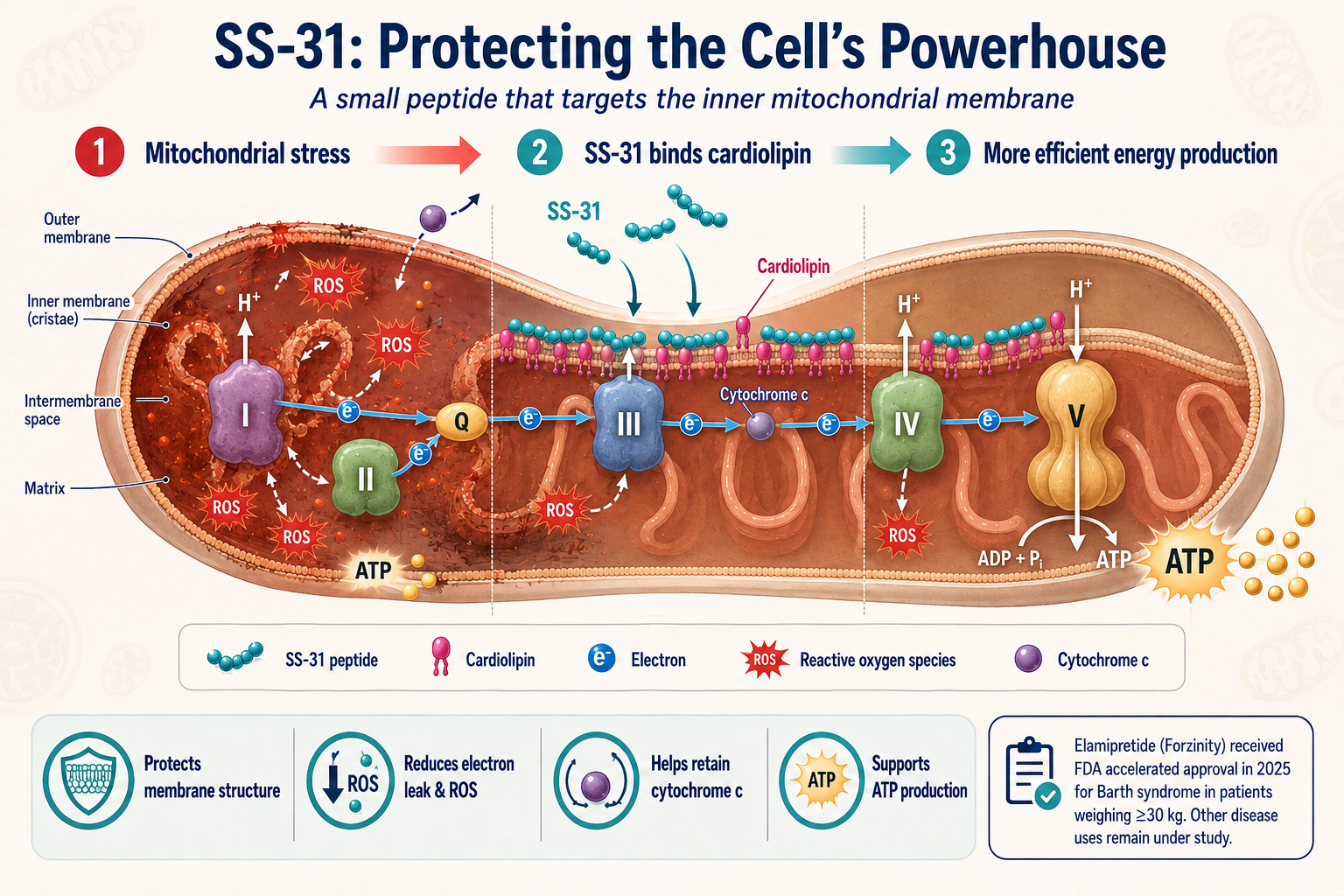
Image created with ChatGPT.
First of all, what even is SS-31? It sounds mysterious, but it’s actually just a peptide, or short chain of amino acids (the building blocks of protein). The Szeto-Schiller (SS)-31 peptide was serendipitously discovered by Hazel H. Szeto and Peter W. Schiller in 2000 while working on molecules that target the μ opioid receptor. In their work, Szeto-Schiller first discovered SS-02, a peptide that demonstrated potent analgesic activity and was capable of crossing the blood-brain barrier (BBB) without the need for specific transporters or receptors. Furthermore, this compound was found to selectively target the inner mitochondrial membrane, the location within mitochondria where the ATP-producing electron transport chain resides. The very high affinity of SS-02 for the μ opioid receptor made it undesirable as a mito-protective compound, due not only to its analgesic effects, but also other adverse μ opioid effects including constipation, respiratory depression, tolerance, and dependence. It was therefore important to develop other mitochondria-targeted peptide compounds that did not have high affinity for opioid receptors. Thus, through a slight change in the order of the SS-02 amino acids, SS-31 was born, a non-μ opioid agonist but highly mito-protective compound.
Now that we know what SS-31 is, how does it work? Well, as previously mentioned, SS-31 targets the inner mitochondrial membrane, where it functions to prevent mitochondrial damage and support efficient energy production. The exact mechanism isn’t necessary to know, but if you’re curious, SS-31:
Binds cardiolipin, a specific type of fat molecule that is essential for maintaining the normal structure of the inner mitochondrial membrane. SS-31 inhibits the oxidation of this molecule, which protects the mitochondrial membrane from damage.
Inhibits cytochrome C peroxidase activity, which would otherwise result in the release of cytochrome C into the cytoplasm and promote apoptosis, or death, of the cell.
Reduces electron leakage and promotes electron transfer. Because the transfer of electrons is the force driving ATP production, these actions promote mitochondrial “respiration” and ATP synthesis.
Reduces the generation of and neutralizes reactive oxygen species (ROS), harmful byproducts of mitochondrial energy production (such as hydrogen peroxide) that result in cellular damage and inflammation. Elimination of ROS is essential for protecting mitochondrial structure.
Based on these actions, what effect does SS-31 have on preventing or managing disease? Well, mitochondrial impairment and oxidative damage are intimately involved in the initiation and progression of many diseases. In humans, SS-31, used as a drug called Elamipretide, has progressed through numerous human clinical trials. SS-31 exhibits protective effects against cardiac, respiratory, retinal, kidney, genetic, and aging-related diseases, as well as sepsis and diabetes (Zhu et al., 2022). In fact, this drug is FDA approved for Barth syndrome, a rare genetic disorder that it impacts energy production in cells because of a problem with mitochondria, leading to weak heart muscles, low white blood cell counts, muscle weakness, and slow growth during childhood.* While a full exploration of these applications is outside the realm of this specific post, for a list of specific trials and more details about them, see the scientific article by Du et al. (2024). For our purposes, it is relevant to note that most of the trials use a dose of 40 mg/day (subcutaneous, or skin, injection).
In addition to contributing to metabolic and peripheral disease states, mitochondrial dysfunction is also involved in neurodegenerative diseases. Because SS-31 can readily cross the BBB, it has the ability to exert potent neuroprotective actions. While these investigations have yet to be completed in human clinical trials, this preclinical literature appears promising for improving prognoses for several neurodegenerative diseases:
In a model of Parkinson’s disease, SS-31 (5 mg/kg) protected dopamine neurons from the cytotoxic effects of MPTP (a synthetic neurotoxin that selectively destroys dopamine-producing neurons) and prevented striatal dopamine depletion (Yang et al., 2009).
In a mouse model of ALS (having a phenotype that closely mimics human ALS with tremors, gait impairment, and paralysis), treatment with SS-31 (daily injections of 5 mg/kg) led to significant delay in the onset of resting tremors, improved motor coordination and balance, and prolonged survival. The improved outcome was associated with a significant reduction in motor neuron cell loss in the lumbar spinal cord, and several oxidative biomarkers were markedly decreased (Petri et al., 2006).
SS-31 can also prevent amyloid β toxicity and increase neuron growth in cells derived from a mouse model of Alzheimer’s disease, supporting SS-31 as potential treatment for Alzheimer’s disease (Manczak et al., 2010).
Overall, mitochondrial dysfunction is implicated in many disease states, for which SS-31 may provide therapeutic benefit. Outside of diagnosed disease, however, SS-31 may still be beneficial. For example, a high fat high sugar “Western Diet” has been shown to result in mitochondrial dysfunction (Langley et al., 2021). Considering most Americans are consuming this type of food occasionally, if not consistently, SS-31 may offset some of the detrimental effects. In one study, for example, administration of SS-31 was able to inhibit the increase in skeletal muscle mitochondrial ROS production following high fat diet in rats, which prevented the development of insulin resistance (Anderson et al., 2009). SS-31 may play a role in reducing mitochondrial damage caused by air pollutants (Gao et al., 2022), as well as promoting recovery after injury (Song et al., 2026) and increasing skeletal muscle function in the elderly (Campbell et al., 2018). SS-31-induced reductions in oxidative stress may also alleviate some side effects of sickness (such as muscle wasting or migraines) (Ballarò et al., 2021; Supinski et al., 2020; Shan et al., 2023), although this has yet to be evaluated in humans.
In terms of safety, SS-31 has been reported to have no effects on normal mitochondria, and is therefore considered relatively safe. In clinical studies, the main adverse effects associated with SS-31 were found to be injection site adverse reactions, such as redness (57%), itchiness (47%), pain (20%), hives (20%), and irritation (10%), most of which were mild. In addition to injection site adverse reactions, dizziness and headaches have also been observed. Serious adverse reactions or fatalities have not been reported (Zhu et al., 2022).
So, here’s the question you’ve all been waiting for: Should I be using SS-31?? (It seems like everyone else is!)
From what we’ve learned today, it appears that this peptide is great for addressing the mitochondrial dysfunction implicated in numerous diseases. Furthermore, SS-31 may improve metabolic health, recovery, and muscle function when these systems are not functioning optimally. However, SS-31 injections should not be your first line of defense against mitochondrial damage. Sleep, nutrition, and exercise are the BEST methods for maintaining the health of mitochondria, and therefore overall brain and body health. That being said, acute use of this peptide may be beneficial in situations of excess physical or mental stress, or for temporary injury or sickness. As always, talk to a certified medical doctor before starting any new peptide or medication! Due to the role of mitochondria in all cellular processes, taking a substance that impacts mitochondrial function may interact with other medications or health states.
*Interestingly, Barth syndrome almost exclusively affects males.
References
Anderson, E. J., Lustig, M. E., Boyle, K. E., Woodlief, T. L., Kane, D. A., Lin, C.-T., Price, J. W., Kang, L., Rabinovitch, P. S., Szeto, H. H., Houmard, J. A., Cortright, R. N., Wasserman, D. H., & Neufer, P. D. (2009). Mitochondrial H2O2 emission and cellular redox state link excess fat intake to insulin resistance in both rodents and humans. The Journal of Clinical Investigation, 119(3), 573–581. https://doi.org/10.1172/JCI37048
Ballarò, R., Lopalco, P., Audrito, V., Beltrà, M., Pin, F., Angelini, R., Costelli, P., Corcelli, A., Bonetto, A., Szeto, H. H., O’Connell, T. M., & Penna, F. (2021). Targeting Mitochondria by SS-31 Ameliorates the Whole Body Energy Status in Cancer- and Chemotherapy-Induced Cachexia. Cancers, 13(4), 850. https://doi.org/10.3390/cancers13040850
Campbell, M. D., Duan, J., Samuelson, A. T., Gaffrey, M. J., Merrihew, G. E., Egertson, J. D., Wang, L., Bammler, T. K., Moore, R. J., White, C. C., Kavanagh, T. J., Voss, J. G., Szeto, H. H., Rabinovitch, P. S., MacCoss, M. J., Qian, W.-J., & Marcinek, D. J. (2019). Improving mitochondrial function with SS-31 reverses age-related redox stress and improves exercise tolerance in aged mice. Free Radical Biology & Medicine, 134, 268–281. https://doi.org/10.1016/j.freeradbiomed.2018.12.031
Du, X., Zeng, Q., Luo, Y., He, L., Zhao, Y., Li, N., Han, C., Zhang, G., & Liu, W. (2024). Application research of novel peptide mitochondrial-targeted antioxidant SS-31 in mitigating mitochondrial dysfunction. Mitochondrion, 75, 101846. https://doi.org/10.1016/j.mito.2024.101846
Gao, M., Liang, C., Hong, W., Yu, X., Zhou, Y., Sun, R., Li, H., Huang, H., Gan, X., Yuan, Z., Zhang, J., Chen, J., Mo, Q., Wang, L., Lin, B., Li, B., & Ran, P. (2022). Biomass-related PM2.5 induces mitochondrial fragmentation and dysfunction in human airway epithelial cells. Environmental Pollution, 292, 118464. https://doi.org/10.1016/j.envpol.2021.118464
Langley, M. R., Yoon, H., Kim, H. N., Choi, C.-I., Simon, W., Kleppe, L., Lanza, I. R., LeBrasseur, N. K., Matveyenko, A., & Scarisbrick, I. A. (2020). High fat diet consumption results in mitochondrial dysfunction, oxidative stress, and oligodendrocyte loss in the central nervous system. Biochimica et Biophysica Acta. Molecular Basis of Disease, 1866(3), 165630. https://doi.org/10.1016/j.bbadis.2019.165630
Manczak, M., Mao, P., Calkins, M., Cornea, A., Arubala, R. P., Murphy, M. P., Szeto, H. H., Park, B., & Reddy, P. H. (2010). Mitochondria-targeted antioxidants protect against Abeta toxicity in Alzheimer’s disease neurons. Journal of Alzheimer’s Disease : JAD, 20(Suppl 2), S609–S631. https://doi.org/10.3233/JAD-2010-100564
Petri, S., Kiaei, M., Damiano, M., Hiller, A., Wille, E., Manfredi, G., Calingasan, N. Y., Szeto, H. H., & Beal, M. F. (2006). Cell-permeable peptide antioxidants as a novel therapeutic approach in a mouse model of amyotrophic lateral sclerosis. Journal of Neurochemistry, 98(4), 1141–1148. https://doi.org/10.1111/j.1471-4159.2006.04018.x
Shan, Z., Wang, Y., Qiu, T., Zhou, Y., Zhang, Y., Hu, L., Zhang, L., Liang, J., Ding, M., Fan, S., & Xiao, Z. (2023). SS-31 alleviated nociceptive responses and restored mitochondrial function in a headache mouse model via Sirt3/Pgc-1α positive feedback loop. The Journal of Headache and Pain, 24(1), 65. https://doi.org/10.1186/s10194-023-01600-6
Song, Z., Ban, Z., Zhao, H., & Mei, X. (2026). Elamipretide (SS-31) promotes recovery by preserving mitochondrial bioenergetics and neural remodeling after spinal cord injury. Neurochemistry International, 197, 106171. https://doi.org/10.1016/j.neuint.2026.106171
Supinski, G. S., Wang, L., Schroder, E. A., & Callahan, L. A. P. (2020). SS31, a mitochondrially targeted antioxidant, prevents sepsis-induced reductions in diaphragm strength and endurance. Journal of Applied Physiology, 128(3), 463–472. https://doi.org/10.1152/japplphysiol.00240.2019
Szeto, H. H., & Schiller, P. W. (2011). Novel Therapies Targeting Inner Mitochondrial Membrane—From Discovery to Clinical Development. Pharmaceutical Research, 28(11), 2669–2679. https://doi.org/10.1007/s11095-011-0476-8
Yang, L., Zhao, K., Calingasan, N. Y., Luo, G., Szeto, H. H., & Beal, M. F. (2009). Mitochondria Targeted Peptides Protect Against 1-Methyl-4-Phenyl-1,2,3,6-Tetrahydropyridine Neurotoxicity. Antioxidants & Redox Signaling, 11(9), 2095–2104. https://doi.org/10.1089/ars.2009.2445
Zhu, Y., Luo, M., Bai, X., Li, J., Nie, P., Li, B., & Luo, P. (2022). SS-31, a Mitochondria-Targeting Peptide, Ameliorates Kidney Disease. Oxidative Medicine and Cellular Longevity, 2022, 1295509. https://doi.org/10.1155/2022/1295509
